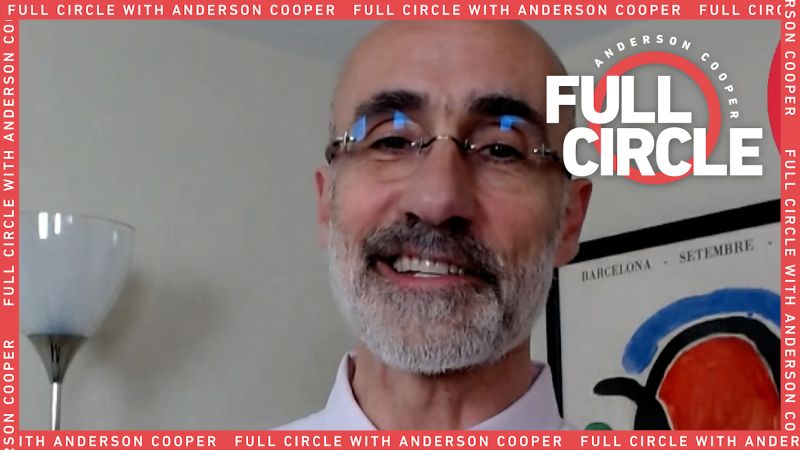







When Dr. Luc Beaudoin was an undergraduate student nearly 40 years ago, he often had trouble falling asleep on Sunday nights and was eager to find a solution.
He found inspiration in a cognitive psychology class he was taking and a professor’s theory regarding visual motion detection, Beaudoin, now a cognitive scientist, said. Visual motion detection refers to the visual system’s ability to perceive and process motion based on changing patterns of light on the retina.
“I thought to myself: If I can understand the human brain’s ‘sleep onset control system,’ I could perhaps devise a technique to trick the brain into falling asleep,” Beaudoin, who is also an adjunct professor of education at Simon Fraser University in British Columbia, said via email. That technique was cemented as “cognitive shuffling” by 2009, when he was 41 and experiencing another bout of difficulty initially falling asleep or falling back asleep after waking up in the middle of the night.
“My insomnia went away,” Beaudoin said. “My girlfriend (now my wife) was amazed that I would fall asleep so quickly. I felt I was onto something important. So, I read more extensively and thought deeply about the sleep onset control system.”
Cognitive shuffling typically involves mentally conjuring up random, impersonal and non-emotionally charged words. For each letter of a word you pick at random, you think of as many corresponding words as you can for five to eight seconds each before moving to the next letter, Beaudoin said.
For the word “piano,” for example, you might think “Pear, parachute, Paul, pirouette … Item, intention, immature, igloo …” and so on. (Beaudoin is also an owner of CogZest and a cofounder of CogSci Apps Corp. and Somnolence+ Inc., all of which develop products based on his research.)
While the technique may not sound calming, it “takes your mind off of your problems and your issues, and helps you get into a more relaxed state of mind,” said Dr. Fariha Abbasi-Feinberg, a sleep medicine physician and neurologist at the Millennium Physician Group in Fort Myers, Florida.
“I always tell patients, ‘You cannot force yourself to sleep. You have to allow yourself to sleep.’ And this is just one of the methods that we use to help with that,” added Abbasi-Feinberg, who often suggests the technique for her patients having sleep issues.
Sometimes you can even visualize corresponding scenarios or movements, such as yourself playing the piano or someone falling with a parachute, Beaudoin said.
READ MORE: Anxiety robbing your sleep? A weighted blanket may help
Here’s the science behind cognitive shuffling, and what to know about practicing it.
Why cognitive shuffling works
At this point, there’s little research on cognitive shuffling. So what makes some doctors back a do-it-yourself sleep hack without substantial evidence?
It turns out that the fundamental theory behind cognitive shuffling, though conjectural, “aligns with established principles in cognitive neuroscience and sleep psychology,” Dr. Leah Kaylor, a clinical psychologist and author based in Louisiana, said via email. It’s based on a large number of studies Beaudoin and other researchers reviewed in a paper published April 2020 in the journal Sleep Medicine Reviews.
In addition to taking the mind off one’s worries, cognitive shuffling “resembles in critical respects natural sleep onset,” Beaudoin said.
In the natural transition into sleep, people tend to have “microdreams” and fragmented, nonlinear thought patterns, Beaudoin and Kaylor said. Intentionally engaging in random, disconnected thinking may replicate this cognitive presleep state, helping people fall asleep.
“We think there’s a positive feedback loop in the brain: Microdreams are not just a product of falling asleep; they cue the brain that it is safe and appropriate to fall asleep,” Beaudoin said.
Since our brains tend to “shuffle” between random thoughts during quieter periods, giving our brains a calming or neutral distraction can be more helpful than allowing them to find something on their own, Dr. Kami McManus, a sleep psychologist in the department of sleep medicine at Penn Medicine in Philadelphia, said via email.
Beaudoin published his third study on cognitive shuffling in 2016. The study’s sample size was small, but its findings were encouraging: 154 college students, most of them female, were randomly assigned to a standard treatment done before bedtime, to practicing a cognitive shuffling exercise more formally known as a serial diverse imagining task (SDIT), or to both.
In the SDIT group, an app randomly presented recordings of words one at a time with eight-second intervals in between, during which participants created and maintained an image of the word until the next recording prompted the next image and so on.
The SDIT group were more likely to experience improvements in sleep quality, difficulty falling asleep and presleep arousal — heightened physical or mental activity while trying to fall asleep. These benefits lasted throughout the semester.
Beaudoin and his team are planning additional research, this time comparing cognitive shuffling to other mental visualization and cognitive techniques.
Imagining yourself to sleep
To practice cognitive shuffling, there isn’t a set number of words or amount of time required. The words you choose for each letter also don’t have to be logically related, Kaylor said — trying to control the randomness will reduce the technique’s effectiveness.
People typically report falling asleep within around five to 15 minutes, while others may take longer, especially if they’re highly stressed or prone to overthinking, Kaylor said.
If you find yourself engaged in the technique for more than 20 minutes or starting to feel frustrated, it’s best to give up and get out of bed, McManus said. Your body may not be ready, so doing a calming activity elsewhere for 20 to 30 minutes before going back to bed and trying again is better than trying too hard and activating negative emotions, making sleep more difficult.
Try this technique several nights in a row before you decide whether cognitive shuffling works for you, these experts recommended. However, remember that it’s not a replacement for proper sleep hygiene or a cure for a sleep condition.
“If someone drinks a lot of coffee before bed, they shouldn’t expect cognitive techniques to help them fall asleep,” Beaudoin said.
Additionally, you should still ensure you have regular sleep and wake times; a bedtime routine involving other wind-down habits such as journaling or taking a warm shower; a quiet, dark and cool room; limited screen time before bed; and no alcohol in the few hours before sleep.
If you regularly have problems sleeping, Beaudoin emphasized that cognitive techniques in general aren’t replacements for medical advice. They’re also not substitutes for cognitive behavioral therapy for insomnia, known as CBT-I, as many cases of insomnia have more than one element in need of treatment.