






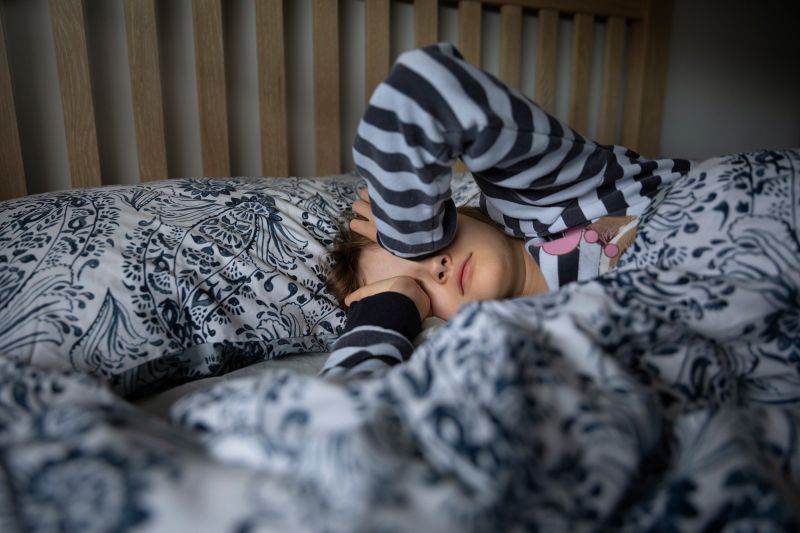
If your child sometimes has trouble sleeping, it may be easy to chalk it up to a phase they will grow out of one day. But a new study suggests possible serious consequences for this line of thought — such as a higher risk for suicidal ideation or attempts when they are older.
Having severe sleep disturbances at age 10 was linked with having a 2.7 times higher risk for suicidal ideation and suicide attempts two years later, according to a study published Monday in the journal JAMA Network Open. Nearly 1 in 3 participants with severe sleep disturbance later reported some level of suicidal behavior.
“Given that sleep is highly visible as a risk factor, non-stigmatizing, and highly treatable … we suggest study of sleep as a risk factor and critical intervention target for youth suicide,” said senior study author Dr. Rebecca Bernert, a suicidologist and founder of the Stanford Suicide Prevention Research Laboratory in California, via email.
Suicide is a leading cause of death among children ages 10 to 14, a group that also has high rates of sleep disturbance, according to the study.
And sleep disturbances “have emerged as an evidence-based risk factor for suicidal behaviors” among adults, regardless of whether a person has depressive symptoms, the authors said. But long-term investigations of suicidal behaviors, specifically in the transition from childhood to early adolescence, have been rare.
That’s why the authors used data from more than 8,800 children recruited by the Adolescent Brain Cognitive Development Study at 21 sites across the United States when they were 9 or 10 years old. At that time, guardians answered questionnaires about their child’s sleep health, which included factors such as problems with falling or staying asleep, waking up, excessive sleepiness, sleep-disorder breathing, excessive sweating during sleep, and behaviors that occur when someone partially awakes from deep sleep.
Guardians also completed forms about their child’s anxiety or depression symptoms. The authors obtained details on family history of depression, family conflict and parental monitoring as well.
When participants were ages 11 or 12, 91.3% of them hadn’t experienced suicidal thoughts or attempts within the two years since the first data collection. But among those who did, high and severe sleep disturbances were linked with greater odds of ideation and attempts — which remained even after the authors accounted for other factors that increased risk, such as depression, anxiety and family conflict or history of depression. Risk was higher among participants of color and female adolescents.
Additionally, having daily nightmares was associated with a five times higher risk of suicidal behaviors.
The findings don’t come as a surprise, as “we know how important sleep is for babies but we forget soon after how key it is for kids, and then in particular at adolescence and pre adolescence,” said Dr. Christopher Willard, a Massachusetts-based psychologist and teaching associate in psychiatry at Harvard Medical School in Boston, via email. He wasn’t involved in the study.
“The brain is changing as much during those years as in that first year of life, which is why that age sleeps so much and needs so much sleep to develop the way it needs to,” Willard said.
The research could have a multidisciplinary impact.
Given the study’s design and large sample size of a younger, nonclinical population, the research has “significant parental, clinical, and public health implications,” said Dr. Rebecca Berry, clinical psychologist and adjunct clinical associate professor at New York University’s Grossman School of Medicine, via email. Berry wasn’t involved in the study.
Why chronic sleep disruption may be linked with suicide
Additional studies that replicate the findings using objective sleep measurements and provide more details on the frequency, nature and emotional impact of nightmares would be helpful, said Bernert, who is also an assistant professor of psychiatry and behavioral sciences at the Stanford University School of Medicine.
“It’s important to note that in a study like this, we don’t want to assume that the poor sleep caused the suicidal behavior — we are just seeing a connection between the two,” said Dr. Neha Chaudhary, a child and adolescent psychiatrist at Massachusetts General Hospital and Harvard Medical School in Boston, via email. Chaudhary wasn’t involved in the study.
It’s possible that sleep disturbances could be early signs of mental health struggles that later worsen, Chaudhary, chief medical officer at Modern Health, said.
But as to what may explain the associations found, “sleep is a barometer of our well-being, and an important window into our physical and emotional health,” Bernert said in a fact sheet provided to the media. “In this way, sleep may fail to provide an emotional refuge for distressed individuals.”
Insufficient sleep quality or quantity may also interfere with brain function, experts said.
“Problems with sleep, lack of sleep — which too much stress, activities, schoolwork and yes, screen time, all contribute to — interfere with brain development on a number of levels, but particularly mood, anxiety and emotion regulation,” Willard said.
This lack of regulation, as well as fatigue, can impair decision-making. The ability to cope with stressors decreases and impulsivity increases, and problem-solving becomes more challenging, Berry said. Sleep also assists with the regulation of neurotransmitter levels, metabolism, brain plasticity and the cleaning of toxic waste proteins from the brain.
Supporting your child’s health
At all ages, your kids need good nighttime habits that support healthy sleep, Willard said.
“Some of this is a larger conversation about homework expectations at that age,” he added, “but in families you can do what you can to keep bedtimes and routines consistent.”
Create a wind-down routine that starts an hour before bedtime, Berry said. It should limit screen time, homework and physical activity as much as possible and include relaxing activities such as light reading, journaling or listening to calming music.
For kids who struggle with restlessness at bedtime, “parents may consider practicing mindfulness strategies with their child to support emotion regulation,” Berry said.
Sleep hygiene is also supported by solid habits during the day — such as exercise, sun exposure, stress management and avoidance of daytime naps, she added.
READ MORE: Moodiness or more? How to tell if your kid’s suffering from a mental disorder
Sleep disturbances are a symptom of many mental health conditions and attention deficit hyperactivity disorder, Willard said.
“So if you notice your child’s sleep patterns changing drastically,” he added, “check with your pediatrician and keep an eye on it, and consider ways to adjust the day and night routines.”
First-line treatments found to be effective for adolescents include cognitive behavioral therapy for insomnia, known as CBTi, and imagery rehearsal treatment for nightmares, Bernert said.
Experts and loved ones can’t always predict a suicide attempt, but sometimes there are warning signs, including extreme mood swings, hopelessness or loss of interest in activities. Have open conversations with your child about their mental health and seek help from a professional.
These types of parental involvement can have profound impacts, experts said. In fact, the authors found an increase in parental monitoring, judged by the child’s perspective — regarding family dinner frequency and knowledge of the child’s location or who they are spending time with — was associated with a 15% lower risk of suicidal behavior.
Editor’s Note: If you or someone you know is struggling with suicidal thoughts or mental health matters, confidential support from trained counselors is available by phone, text or chat by dialing 988 or visiting the 988 Lifeline website.