

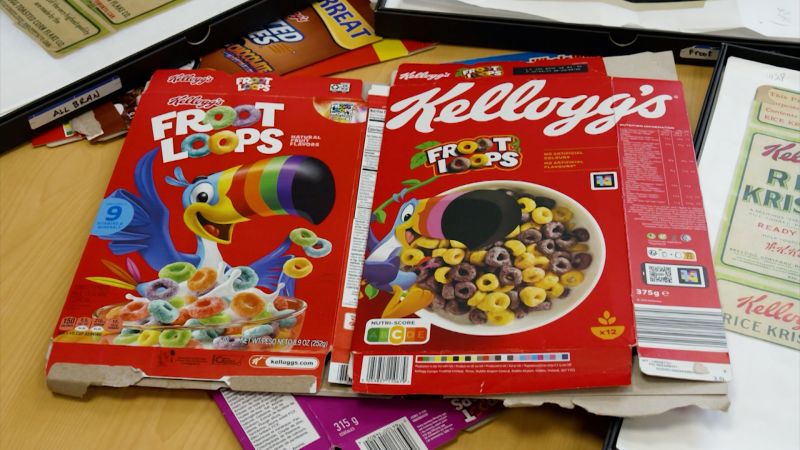




As artificial food dyes are becoming increasingly restricted at state and federal levels, some manufacturers are looking to switch to natural dyes to color their food products.
US Food and Drug Administration Commissioner Dr. Marty Makary announced in an April 22 briefing that the agency plans to work with industry to phase out the use of petroleum-based synthetic dyes in the US food supply.
Those dyes are commonly used to make food and beverage products brightly colored and more appealing to consumers. They include red No. 40, yellow No. 5 and No. 6, blue No. 1 and No. 2, and green No. 3.
Natural food dyes, which could replace them, are derived from vegetables, fruits, animals and minerals, according to the FDA.
Makary’s announcement is the latest move in the push to get food companies to stop using artificial dyes due to concerns about negative impacts on animal and human health — including increased risk of cancer and neurobehavioral issues.
The FDA also soon aims to authorize four new natural colorants and fast-track the review of others, including Galdieria extract blue, gardenia blue, butterfly pea flower extract and calcium phosphate.
“The FDA is asking food companies to (voluntarily) substitute petrochemical dyes with natural ingredients for American children,” Makary said in a news release. “… Given the growing concerns of doctors and parents about the potential role of petroleum-based food dyes, we should not be taking risks and do everything possible to safeguard the health of our children.”
The movement to ban artificial dyes
The FDA announcement follows significant shifts in the legal landscape around food additives over the last two years. California banned red No. 3 statewide in October 2023, followed by a ban of six other common dyes in school foods in August.
The FDA banned red No. 3 in January, effective for food on January 15, 2027, and for drugs on January 18, 2028 — but the agency is now asking food companies to eliminate the dye sooner. And in March, West Virginia passed the most sweeping law thus far, prohibiting seven dyes and two preservatives.
“For a couple of decades, at least, there has been a lot of questioning from consumers about the safety of synthetics, and the demand for more natural ingredients has been on the rise,” said Dr. Monica Giusti, professor and associate chair of the food science and technology department at Ohio State University. “Finally, we have seen some type of regulatory action.”
Some natural dyes are already being used in products sold in the United States, and some stores have policies barring the sale of foods with synthetic dyes, said Melanie Benesh, vice president of governmental affairs at the Environmental Working Group, a nonprofit environmental health organization.
Here are the alternative dyes and how they could affect manufacturers and human health.
Natural sources of color
Many natural dyes are already approved by the FDA and regulated differently than their artificial counterparts. The FDA requires manufacturers submit samples of batches of synthetic colors for testing and certification. Natural color additives are exempt but still evaluated by the agency.
One of the most popular alternatives for vibrant red colorants is cochineal extract or its lake, carmine. (A lake is a fat-soluble version of a dye.)
Cochineal dyes are from the tiny dried and crushed bodies of female cochineal insects mostly and easily harvested from cacti in Peru, Giusti said. So intensely colored that just crushing them with your fingers will leave a stain, cochineal insects have been used as colorants for centuries, dating back to the Inca civilization that began in the 13th century, Giusti added.
Other natural dyes include annatto extract (yellow) from the seeds of the tropical tree Bixa orellana and blue-to-brown colorants produced from juiced, powdered or dehydrated beets, experts said.
There’s also beta-carotene (yellow or orange) found in many plants including carrots; grape skin extract (red or purple); the orange- and red-hued spices turmeric and saffron; and green-colored chlorophyll, spirulina extract and matcha, experts said.
“There are various processing methods for naturally derived food colors, with some colors having multiple methods available,” said Renee Leber, food science and technical services manager at the Institute of Food Technologists, a nonprofit scientific organization of food professionals and technologists, via email. The institute’s membership includes people working in food production.
Little research on natural dyes
Research on the effects of artificial dyes on human health is still underfunded, so there’s even less support for studies on natural alternatives, experts said.
But generally, “compounds that give color to fruits and vegetables tend to have additional beneficial properties for human health,” such as anti-inflammatory agents, Giusti said.
A small percentage of consumers have reported experiencing reactions ranging in severity from hives to anaphylactic shock, which can be fatal, after consuming products containing cochineal insect dyes, according to the Center for Science in the Public Interest. The ingredients have therefore “been identified as allergenic substances that must be declared on the label of all food and cosmetic products,” according to the FDA.
“There’s some protein in these dyes to which some people are allergic,” said Dr. Marion Nestle, Paulette Goddard Professor of Nutrition, Food Studies, and Public Health, Emerita, at New York University. “That could occur in sensitive people with very, very small quantities.”
But with most natural dyes coming from plants and being used in small quantities, “it’s hard to believe they’d have any effect” on the general population, added Nestle, also visiting professor of nutritional sciences at Cornell University in Ithaca, New York.
The switch won’t be easy
Even if natural dyes may generally be safer for human health, there is industry concern about potential impact on product appeal and feasibility.
One reason why manufacturers prefer petroleum-based dyes is that their chemical structure doesn’t change much when combined with other ingredients, stored over time and exposed to elements, Giusti said. While cochineal insects provide intense, stable colors, dyes from plant materials are less stable.
That difference is “very challenging for companies, because, for example, if a company produces 10 different products that are red, they could be using one synthetic colorant,” Giusti said. “But if they want to replace the synthetic colorant with a natural alternative, they may need to use up to 10 different natural colorants.”
And although there are more than 40 different alternatives of natural colorants, they can’t produce the spectrum of color that the several synthetic dyes can. These factors may cause products containing natural dyes to be more expensive than those with synthetic colors.
Converting just one product from a synthetic dye to a natural colorant can take six months to a year, officials at Sensient Technologies Corp., one of the largest global dye-makers helping businesses change their protocols, told The Associated Press.
“It’s not like there’s 150 million pounds of beet juice sitting around waiting on the off chance the whole market may convert,” Paul Manning, the company’s chief executive, told the AP. “Tens of millions of pounds of these products need to be grown, pulled out of the ground, extracted.”
It’s the same supply issue with cochineal dyes. Roughly 70,000 cochineal insects are needed to produce about 2.2 pounds, or 1 kilogram, of dye, the AP reported.
Some food companies have previously received backlash when switching to natural dyes, with some consumers reporting a difference in taste. But Nestle said these experiences are likely biased perceptions since products’ compositions otherwise typically remain the same.
Companies have “managed to get rid of them in other countries and substitute vegetable dyes,” Nestle said. “This seems like a no-brainer to me.”